


On January 1, 2026, the new-generation cutting and hemostatic device independently developed by Hangzhou Chaobo Medical Technology Co., Ltd. —— Starion® Knife obtained the marketing approval from the National Medical Products Administration!
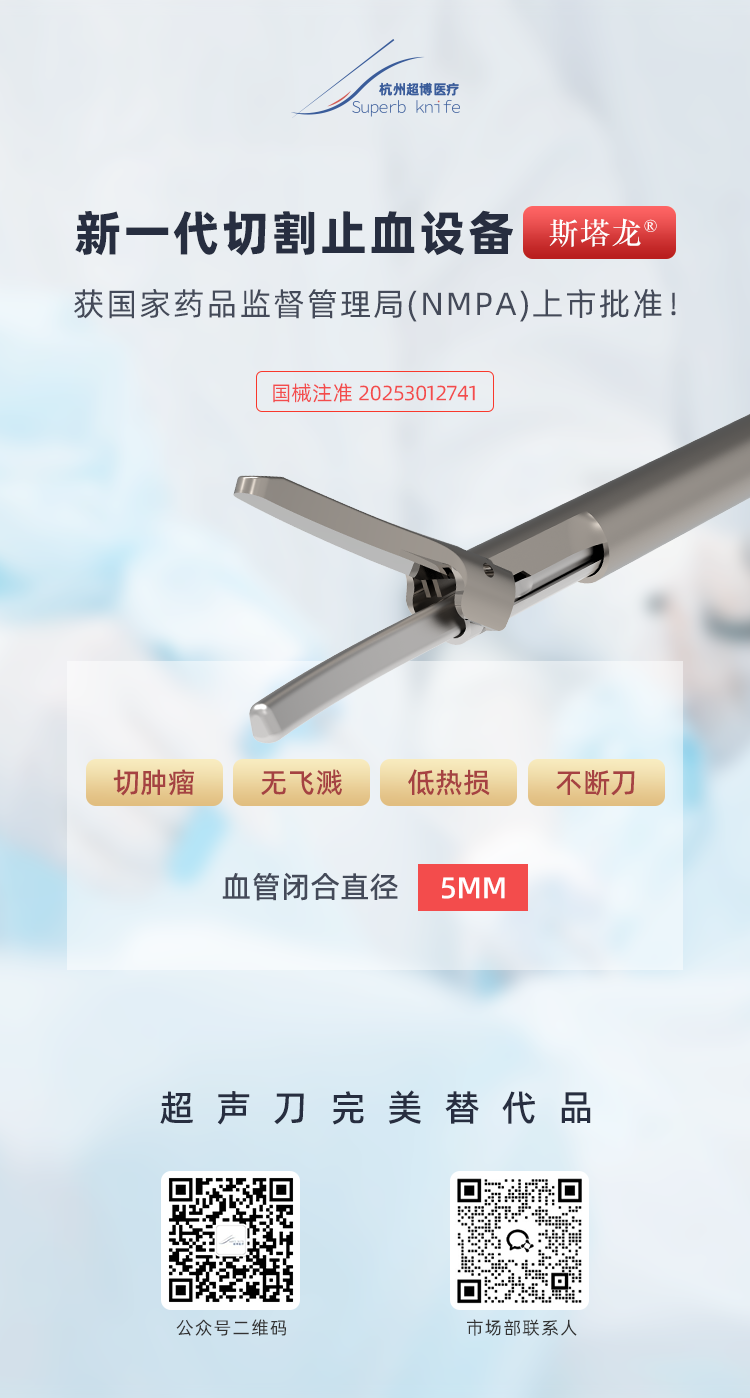
Original technology breaks the monopoly and creates a new path for energy surgery
For a long time, the cutting and hemostasis in surgery have mainly been performed by ultrasonic scalpels, with more than 80% of the domestic market share monopolized by foreign companies. Starion Scalpel takes a different approach, adopting non-ultrasonic technology to achieve rapid tissue cutting, hemostasis, and large blood vessel closure. It matches the performance of ultrasonic scalpels while avoiding the limitations of ultrasonic scalpels such as splashing and blade breakage. It has obvious advantages in performance and cost and can perfectly realize domestic substitution.
No splashing, avoids tumor dissemination, making surgery more reassuring
Unlike ultrasonic scalpels, which rely on ultrasonic vibrations and are prone to generating aerosols, the Starion scalpel does not produce "ultrasonic atomization" during operation. This fundamentally eliminates the potential risk of dissemination caused by cell splattering during tumor resection surgeries, providing crucial technical safety guarantees for the implementation of the "tumor-free principle" in oncology surgery.
Low heat damage, no knife breakage, safer surgery
The Starion Knife achieves tissue cutting and coagulation through precise control of energy, without relying on heat generated by tissue vibration itself. It causes less thermal damage and a milder tissue inflammatory response, which is beneficial for patients' postoperative healing. At the same time, it fundamentally eliminates the risk of "blade breakage" associated with ultrasonic scalpels, improves the certainty and fluency of surgeries, and ensures patient safety.
No electric current, breaking through the energy forbidden zone, with broader applications
Traditional electrosurgical instruments are contraindicated in surgeries involving the heart, brain, nerves, and patients with implanted cardiac pacemakers because the electric current passes through the human body. The innovative principle of the Starion Knife ensures that the electric current itself does not pass through the human body during cutting, making it safely applicable to patients with cardiac pacemakers and surgical procedures in electrically sensitive areas such as the heart, brain, and nerves. This fills the gap in the clinical application of existing energy-based instruments.
Seamless integration with clinical practice, initiating the "zero adaptation period" upgrade
The Starion Knife adopts a structural design similar to that of an ultrasonic scalpel. Doctors can utilize its full performance with "zero learning cost" without changing their techniques. This smooth replacement path can help it achieve rapid popularization. In terms of core performance, the Starion Knife has been approved for 5mm large blood vessel sealing capability this time, and will further apply for 7mm large blood vessel sealing. It is suitable for almost all open and laparoscopic surgical fields, including general surgery, hepatobiliary surgery, urology, gynecology, thyroid and breast surgery, etc. In addition, with its optimized structure and significantly reduced single-use cost, the Starion Knife provides surgeons with an extremely attractive option with the best cost-performance ratio under the current general environment where China's medical sector is implementing DRGS.
Integration of medicine and engineering, clinical wisdom empowers product innovation
During the research and development process, Dong Jiahong, an academician of the Chinese Academy of Engineering from Beijing Tsinghua Changgung Hospital, personally guided the equipment improvement and animal experiments. Subsequently, at Sir Run Run Shaw Hospital Affiliated to Zhejiang University School of Medicine and the National Engineering Research Center for Minimally Invasive Medical Device Innovation and Application, the first batch of Starion Knives' clinical verification work was completed under the leadership of the team of Cai Xiujun, an academician of the Chinese Academy of Sciences. This process has embodied the collective wisdom of China's top surgeons and engineers, ensuring the scientificity and reliability of the entire chain of the product from principle to application.
Liu Hongmei (a doctor who studied in the United States), the chief scientist of the founding team of Hangzhou Chaobo Medical, said: "The birth of the Starion Knife stems from our team's profound understanding of the concepts of precision surgery and value-based healthcare. Starting from the basic biological effects and clinical outcomes, we have continuously carried out innovative research and development to create more precise, more convenient and safer products."
Looking ahead: Leading a new journey of disruptive technologies
Starion Knife is not only a perfect substitute for ultrasonic scalpel, but also a brand-new species. With its excellent product performance and significant economic advantages, it will break the situation where foreign products have long monopolized China's surgical cutting and hemostasis market. The launch of Starion Knife provides domestic medical institutions with a domestically-made option with excellent performance and economic efficiency, which is expected to significantly reduce the procurement costs of medical institutions and the treatment burden of patients, and promote the popularization of high-end medical technologies.
About Chaobo
Chaobo Medical is a high-tech medical device company focusing on the field of precision surgery. We have always been based on clinical needs, deeply collaborated with surgeons, carried out innovative research and development starting from first principles, and are committed to integrating refined, intelligent, efficient, and humanized technologies into all aspects of surgical operations. We develop surgical products and solutions with excellent biological effects, clear clinical value, convenient operation experience, and good economy, serving surgeons worldwide and benefiting patients around the world.